
Send this article to a friend:
February
11
2026
|
Send this article to a friend: February |
The Hidden Cost of Government Spending (It Isn't What You Think)
It never ceases to amaze me how often big decisions are judged only by their short-term results. A policy “works,” at least on paper. A problem appears to be solved. And the longer-term consequences – the ones that unfold slowly, quietly and predictably – are treated as someone else’s problem. That pattern shows up everywhere in life. But it’s especially common in government, where the incentive is always to deliver immediate relief while postponing the cost. History shows this again and again. When policymakers focus narrowly on today’s pain, tomorrow’s trade-offs tend to get ignored. And those trade-offs don’t disappear. They accumulate. That brings us to government spending and the deficit. Most people understand the headline problem: we spend more than we take in. What almost never gets discussed is the secondary consequence of that imbalance – the one that quietly limits what’s possible later on. According to long-term projections from the non-partisan Congressional Budget Office (CBO), rising debt increasingly limits future options as interest costs consume a larger share of federal spending. And whether we acknowledge it or not, that consequence is already shaping the choices ahead of us… The Unspoken Impact Of The Known CauseNow, the cause of what we’re talking about is known. We know that governments, especially our federal government, spend too much. Whether it’s spending $20 billion to going to Argentina to help their economy or proposals to reimburse oil companies for the rebuilding that they’ll have to do to make Venezuela a major oil producing country again or any number of other massive amounts to be spent on all kinds of causes and purposes, our federal government spends tons of money (literally, if you weighed it in paper bills or coins). There is some good news on the spending front, though. In 2025, according to the Independent Institute, the federal deficit grew slower than in the previous year, which is a good thing. But slower growth of the deficit is not reduction of the deficit. Reduction of the deficit would take much bigger spending cuts or increased taxes (or both). And neither of those actions are politically popular. For every politician willing to bring the government’s budget in line, there are several challengers for that office who will happily sell out everyone’s future to keep paying for stuff now without increasing taxes. (Yes, there are a few politicians who fight that good fight over the budget, but I can count them on one hand… out of the 535 members of Congress.) And if you think that we have a savior in the Fed, it’s important to understand that… The Federal Reserve can’t fix this It’s important to understand what the Federal Reserve is – and just as important, what it isn’t. The Fed’s official mandate is limited:
That’s not a blank check to solve structural fiscal problems, and it was never designed to be. There’s no specific reference to a 2% inflation target. “Moderate” isn’t even defined! What is a “moderate” long-term interest rate in a nation where rates have been set as low as 0.06% and as high as 19%? You can see the limits of that mandate in hindsight. Over the course of its existence, the U.S. economy has experienced repeated recessions and periods of instability – sometimes mild, sometimes severe – despite the Fed’s best efforts to smooth them out. Inflation tells a similar story. While the Fed currently targets a long-run inflation rate of 2%, the historical record shows that average inflation since the Fed’s founding has been closer to 4%. In other words, even when policy is aimed at stability, purchasing power has vanished over time at nearly twice the targeted rate! Now, this isn’t an accusation – it’s a recognition of reality. Monetary policy can influence some areas of the economy. What the Fed can’t do is offset decades of persistent overspending. The Fed can’t eliminate the consequences of all that debt. And this is where long-term choices start to matter. When the Fed prioritizes short-term relief without considering future trade-offs, that has a long-term cost. It reduces their flexibility. Their options don’t disappear all at once, either (we’d notice that). Rather, they narrow gradually. Think of it the same way you would personal budgeting. If someone routinely spends more than they earn and borrows to make up the difference, there eventually comes a day where lenders hesitate. Those who do keep offering loans do so at higher cost. More and more of their income goes to pay refinancing costs. The worst-case scenario, of course, is suddenly being cut off from credit altogether... The federal government faces a similar dynamic. As debt grows, a larger share of revenue goes toward interest payments alone. That leaves less available for programs and promises people already depend on. At that point, the White House is left with fewer workable choices. They must choose between reducing benefits (spend less), boost revenue to pay for rising costs (tax more) – or allow inflation to do the balancing quietly. Across history, governments around the world nearly always choose the third option. It’s important to understand that none of those paths is a crisis. There’s no “fire alarm” moment. The consequences are more subtle – making everyday life both more expensive and less predictable… Let’s get realistic Again, I’m not saying this is the end of the world. Or that the U.S. will turn into a Mad Max-style wasteland. The #1 mistake of most people who discuss this issue is that they shout “Disaster!” They wave their arms and pound the table and prophesize imminent doom. They’ve been doing that since the late 1970s – and so far, just look around. Nobody’s brawling over a can of dog food. Folks aren’t shooting crossbows at each other. Because we’ve heard these people cry “Wolf!” for decades now, we started to let ourselves believe that maybe the debt doesn’t really matter. Unfortunately, both perspectives are wrong. No, I’m laying out the reality of what happens when they can’t borrow enough to keep up with spending: They don’t get to choose anymore. Once they can no longer borrow enough to keep up with the debt repayments alone, the federal government has to start living paycheck-to-paycheck. That means slashing spending. Cuts start at the margins (the edges, where the amounts spent are relatively small). Then they move into the bigger-ticket budget items… the federal government reduces the amount of cost of living increases for Social Security and Medicare. They stop fully covering certain services (higher copays for prescriptions and doctor visits, for example). Cutting services loses elections, though – which is why governments almost never seriously tackle spending. The solution is to print money. The Fed prints money to make the debt payments. Lenders get a devalued currency, the government stays solvent. Obviously, that wrecks the dollar’s purchasing power – so the cost of living rises (just like it has been, steadily, for a century now). In any of these scenarios, the government continues. Our nation survives. It’s citizens, people like you and me, who pay the price. Earning, saving and spending in a depreciated currency. That means our choices will be limited, too. Our choices will be limited by this destruction of our purchasing power. That’s the real risk. Not a crisis, not a sudden collapse – just the slow and steady daily devaluation of our savings. The gradual reduction of our future options. That’s not a problem any single administration or four-year Presidential term can overcome. If you’re like me, you treasure your freedom. You want to choose your own destiny. To stay in control of your choices and your future. That’s a big reason that more and more people are choosing to diversify their savings with physical precious metals. Physical gold and silver are inflation-resistant, can’t be printed or inflated away. If you’d like to find out more about diversifying into precious metals to see if they make sense in your savings, you can learn more with your free copy of our Precious Metals Info Kit.
|
Send this article to a friend:
 |
 |
 |
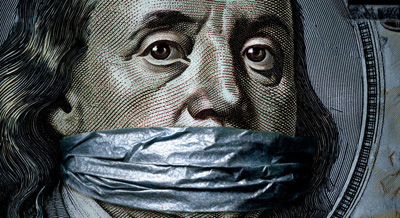 Government overspending has an unintended consequence that rarely gets mentioned: It quietly strips away our options. As debt grows, interest costs crowd out options – leaving fewer ways to meet obligations. This is what happens next…